
About us
Most patients in everyday clinical practice live with more than one condition or disease. However, Multimorbidity is not simply the coexistence of two and more conditions, diseases, or illnesses in a single patient; it is the dynamic and interfering interaction of acute and chronic conditions, treatments, and contextual factors within an individual and within the context of his health care professionals, caregivers, relatives, and the health care system.
These interactions between conditions, diseases, and illness can alter symptom patterns, obscure diagnosis, and create competing or conflicting management and treatment priorities. Thus, a measure or a therapy that improves one condition or disease may worsen another, i.e., disease-disease interactions (DDIs), creating dilemmas in medical everyday clinical decision-making.
Medical doctors and other health care professionals need to deal daily with complex constellations within the framework of disease–disease interactions (DDIs ) with sometimes crucial clinical consequences. They aim at delivering comprehensive, coordinated, continuous care. Multimorbidity and complexity are no longer niche topics; they define everyday medicine more than ever. Yet most health systems, training pathways, and guidelines remain organized along single diseases and written by specialized professional medical boards—contributing to fragmented care, avoidable complications, unnecessary stress for patients, caregivers, and healthcare teams. This again substantially increases cost of care.
The International Center for Multimorbidity and Complexity in Medicine (ICMC) aims to close this essential gap.
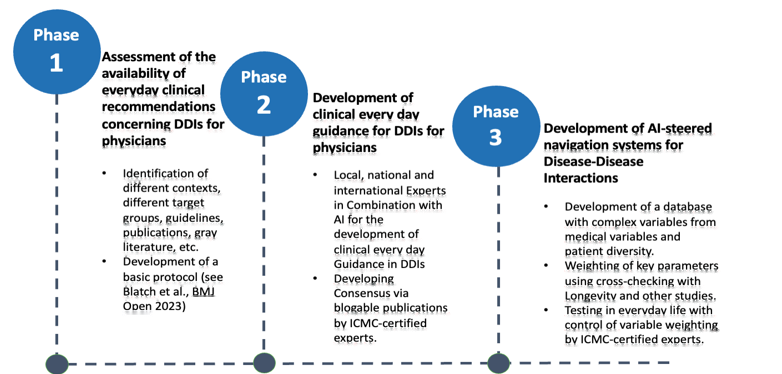
- Phase 1: In a first phase we analyze currently available scientific Evidence on very prevalent DDIs, mostly but not exclusively Cardiovascular Disease and concurrent Mental Health issues.
- Phase 2: In a second step we access the know-how of experienced health care professionals involved in decision making about measures to be taken in patients with DDIs.
- Phase 3: In further steps we develop and offer freely accessible Everyday Clinical Guidance on specific DDIs, i.e., structured, operational support for health care professionals to manage DDIs at the bedside and in ambulatory care in everyday clinical practice.
Background and rationale
The International Multimorbidity Organisation/ICMC approaches DDIs. i.e., the often-under-recognized ways in which conditions and treatments collide in one person. Unfortunately, DDIs are rarely addressed explicitly in traditional guidelines, and multimorbid patients are commonly underrepresented in clinical trials. The core challenge is frequently not the number of diagnoses, but the consequences of their interaction, for example when dealing with cardiovascular diseases and their interference with other diseases such as mostly ignored mental health issues optimization (depression or anxiety). Clinicians are therefore forced to rely heavily on experience, individual risk tolerance, and ad hoc problem-solving. Our work responds directly to this structural gap: we aim to make complexity operational in everyday clinical practice—transforming real-world dilemmas into structured, shareable knowledge, guidance documents, and digital decision-support tools.
What we produce
1. Reviewing available Information
- Available Scientific Evidence and guidelines concerning DDIs
- Synthesis of gaps, including where guidelines conflict or fall silent
2. Reviewing available Information from Everyday Practice on DDIs
- Real-world routines and expert practice (how clinicians actually manage DDIs)
3. Developing, Structuring, and Validating Everyday Clinical Guidance built for every-day clinical tasks
- Real-world routines and expert practice (how clinicians actually manage DDIs)
- Hybrid AI-supported analysis to surface hidden risks, detect uncertainty hotspots, and improve consistency
- Interdisciplinary validation, with peer-review by international experts across relevant specialties and professions
Who we serve
International Multimorbidity Organisation / ICMC primarily serves three groups:
- Clinicians and healthcare teams
- Primary care physicians, specialists, nurses, psychologists, and allied professionals
- Downloadable Everyday Clinical Guidance on common DDIs
- Transparent insight into how experienced experts manage real-world complexity
- Patients and caregivers
- Clear explanations of multimorbidity as interaction—not simply “many diseases”
- Visibility into which DDI topics are currently under development
- Partners and supporters
- Hospitals, universities, professional societies, insurers, foundations, and donors
- A clear view of ICMC’s method, outputs, and how support translates into clinical impact
Visions and Objectives
Our aim is pragmatic and patient-centered: safer, clearer care for complex patients and less uncertainty in daily decision-making for clinicians.
We work in a structured pipeline:
- Identify concrete gaps in evidence and real-world routines
- Build and analyze detailed cases (including AI-supported synthesis and risk detection)
- Develop operational guidance through structured interprofessional panels
- Prepare guidance for validation in clinical settings
- Translate guidance into digital navigation tools that can support step-by-step decisions and adapt to the individual patient
Long-term, we aim to reduce avoidable complications, prolonged and circuitous patient journeys, and unnecessary costs associated with fragmented care.
Current clinical focus
Our initial focus is on high-prevalence, high-impact DDIs at the somatic–psychiatric interface, including:
- Cardiovascular disease and mental disorders (e.g., depression, anxiety, PTSD)
- PPPD (chronic Dizziness) and anxiety
These clusters are selected because improved guidance can meaningfully improve outcomes, quality of life, and resource use.
Main aims across projects
- Improve clinical decision-making in complex situations
We integrate evidence-based medicine, experience-based practice, psychological aspects of medical decision-making, and AI-supported analytics—especially where guidelines collide or are absent. - Develop and disseminate operational DDI guidance
We create structured guidance and tools spanning screening, diagnosis, therapy selection, follow-up, and interdisciplinary coordination for defined DDI constellations. - Reduce uncertainty and stress for clinicians and patients
By providing navigational support, we aim to reduce cognitive burden and decisional stress in complex cases, with downstream benefits for patient experience and outcomes. - Strengthen learning health systems for multimorbidity
Through collaborations with academic and clinical partners and professional societies, we build a modular, scalable architecture that feeds back into practice via guidance, prototypes, training formats, and open-access dissemination.
International networks
ICMC contributes to collaborative networks addressing multimorbidity and complexity, including engagement with European and national working groups focused on multimorbidity and AI in internal medicine.
Selected projects (examples)
Cardiovascular conditions or disease and depression/anxiety (ongoing)
Depression and anxiety disorders are common in patients with cardiovascular disease, for example hypertension and worsen quality of life and prognosis. DDIs complicate symptom attribution, screening, and therapy selection (including medication choices). An initial study evaluates how clinical practice guidelines address depression in cardiovascular disease and whether they provide operational guidance suitable for outpatient and primary care settings.
PPPD and hypertension (ongoing)
Persistent Postural-Perceptual Dizziness (PPPD) is a disease with very disturbing, often debilitating and disabling chronic functional dizziness, often accompanied by severe anxiety and autonomic arousal. Some of these In patients who also live with arterial hypertension, DDIs are frequent and clinically challenging: dizziness may reflect PPPD, blood pressure dysregulation, medication effects, or anxiety, and treatments (e.g., antihypertensives, SSRI/SNRI, vestibular rehabilitation, psychotherapy) can pull in different directions..
Autism spectrum disorder (ASD) and hypertension (ongoing)
Adults with ASD increasingly present with age-related conditions such as hypertension, yet operational guidance is scarce on how to manage cardiovascular risk in the context of sensory sensitivities, communication differences, co-occurring mental disorders, and complex medication regimens. This project follows the same methodological framework as PPPD–hypertension.
AI-supported navigation for DDIs (planned)
We will develop GPTs for decision navigation in the above-mentioned DDIs.
Total hip replacement and depression/anxiety (ongoing)
This project examines perioperative and postoperative DDIs affecting recovery, readmission risk, patient behavior, and outcomes—aiming to translate evidence into practical guidance for orthopaedic teams and collaborating professionals.
Impact for clinicians
ICMC’s Everyday Clinical Guidance is designed to:
- make DDI risks explicit and clinically actionable
- reduce ambiguity when guideline recommendations conflict
- support safer, more consistent decisions across teams and settings
- improve interdisciplinary coordination and continuity of care
- shorten avoidable diagnostic and therapeutic detours
- reduce effort and cost